
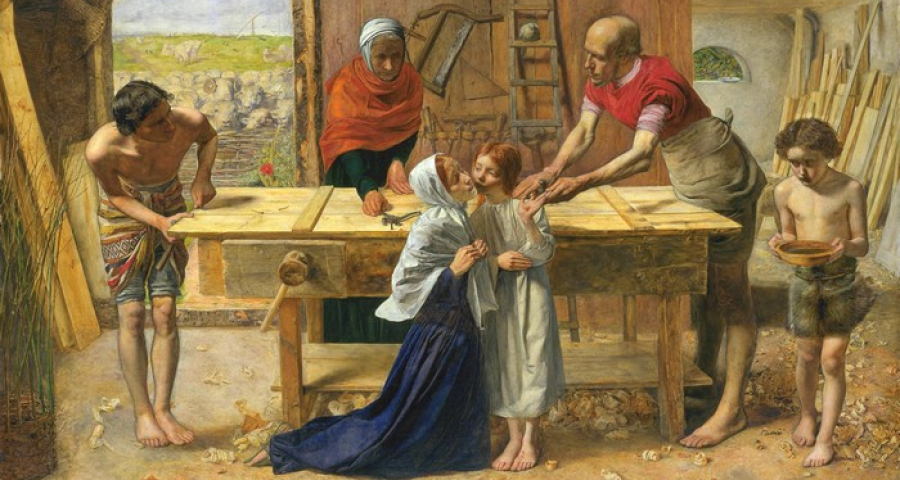
Scholar Joan Taylor takes a historical approach to investigating what we know about Christ's early years and the context in which he lived.
by Luigino Bruni
published in Agorà di Avvenire on December 24, 2025
To delve into the content of Joan Taylor's La vera storia di Gesù Bambino, Sonda, 2025 (Boy Jesus: Growing Up Judaean in Turbulent Times, SPCK Publishing, 2025), it is best to start with the conclusion: ‘This book has examined what we can know about Jesus’ childhood thanks to literary and archaeological evidence [...]. We have seen that there is generally deep skepticism among historians: it is not certain that we can know anything about Jesus before his mission as an adult. It is often claimed that he was born in Nazareth, even though no early Christian source states this. Similarly, there is also a widespread hypothesis that he was not a descendant of David, despite this being widely documented in early Christian literature.“ She concludes with her general thesis: ”A skepticism that we have challenged here." In fact, according to Taylor, who is a serious and accredited scholar of Christian origins and Second Temple Judaism, “it seems clear that Jesus was a child burdened with high expectations, a weight that came from the past and shaped a clear Jewish identity, marked by his Davidic descent, by being a native of Bethlehem but torn away from his ancestral home, a refugee in Egypt and an emigrant to Galilee, aware of persecution.”
A well-written, documented, and serious book, despite being aimed at a non-specialist audience, it is very valuable for gaining a good understanding of the historical and religious context in which Jesus was born and lived his childhood (the book ends with the child Jesus being presented at the temple). Taylor does not present any particularly new theories about Jesus' childhood, especially if we compare her book with studies from the last fifty years, since exegetes and historians began to take the historical data reported in the Gospels seriously, no longer dismissing them too quickly as myth or narrative fantasy of the evangelists, as had been done since at least the 19th century, especially in Protestant circles. The most recent research has reversed the burden of proof: before discarding a piece of information reported in the New Testament, it is necessary to provide historical evidence to the contrary, otherwise it is best to trust those ancient authors. This is what Taylor does, recovering some elements of historicity on ancient questions that historians of the past had dismissed as unfounded. These include the accounts of the childhood of Matthew and Luke, the only two of the canonical gospels that mention it, with important differences—the centrality of Joseph in Matthew, that of Mary in Luke, the royal setting (the Magi, Herod) in Matthew and the poor setting in Luke (the shepherds), and many others. Taylor also highlights other details found in some apocryphal gospels, particularly the Protoevangelium of James and the Gospel of the Hebrews.
Much space is devoted to various issues related to Jesus' family and relatives, which have always been those about which historians have had the greatest and most radical doubts, touching on some central aspects of Catholic tradition and Marian dogma (Mary's perpetual virginity, the Immaculate Conception, etc.). She also dwells at length on the vexata questio of the historical birthplace of Jesus—Bethlehem or Nazareth: Taylor leans toward the former—and on the historicity of the Massacre of the Innocents, the Magi, and the star. The English scholar discusses the various ancient and recent hypotheses in the light of archaeological excavations (which feature heavily in the book), presents the many theses of scholars, shows the difficulty of these accounts on a historical level, and then adds, in line with her basic approach: “but that does not mean that the events were all completely false.” This is a conservative reading, which some would call conservative (resorting to the hypothesis of the infancy gospels based on the memories of Jesus' family members), but which, honestly, does not bother us, not least because it is always presented with respect and with the benefit of the doubt. However, we are less inclined to follow her when, regarding the historicity of the Magi, she goes so far as to say, with considerable creativity: "There may be a memory of a real star identified by some magi who came to Jerusalem and then went to Bethlehem, an event that infuriated Herod. The crux of the story may not be that the magi went ‘to the baby Jesus’, but that they came to visit Jerusalem, searching for a child on the basis of a royal horoscope, which raised expectations that a great king had been born, especially since Herod's death seemed imminent. In this case, what about possible family memories?'.
We actually know very little about Jesus' family and childhood. And Taylor is well aware of this, even though she likes to present the theological accounts of childhood as potentially historical, or at least not incompatible with history.
From the four canonical gospels (and some apocryphal ones) we read a few important things about Jesus' family, particularly his mother and his brothers and sisters, who, as Taylor points out, were probably six: James, Salome, Joset, Mary, Judas, and Simon. Mark already shows some tensions between Jesus and his family clan. These conflicts are important for many reasons. They reveal the revolutionary significance of the person and message of Jesus and his disciples. Jesus was like Jeremiah, who also found his first adversaries in his family in Anathoth. John also reports a certain family hostility: “Even his brothers did not believe in him.” Jesus is explicit in stating that his family has now become another, an essential element for the birth of the Church, where, however, his family members continued to have a significant influence: think of James, “the brother of the Lord,” of whom Paul speaks (1 Cor 15). For Christians, the most important blood becomes another, which generates a new brotherhood and sonship in the Spirit. In the light of all the Gospels, it seems that kinship is an additional obstacle, not a help, to understanding Jesus' message. In the ancient world, the family was a fundamental institution; it was impossible to ignore family ties within broader social relationships. The family network was the way to enter society (every person was always the son or daughter of, brother or sister of, father or mother of...). The self was not an autonomous entity for delineating and defining a person in that world; there was a need for a broader “we” within which the still very fragile self could be placed.
The role of Jesus' “brothers” is important. Already in the episode of the wedding at Cana, the brothers are not disciples, they are flesh and blood brothers (adephoi). The Gospel of John shows us a “movement” of Jesus composed of (at least) three groups: 1) the apostles, 2) the disciples (some itinerant, others sedentary, but all listening to his word and “believing” it), 3) his family, that is, his mother and brothers (neither his father nor his sisters are mentioned). The brothers do not seem to be qualified as disciples but as a special and separate group, which nevertheless has its role and influence in the public life of Jesus from the beginning.
Taylor tells us that we have no exegetical or biblical theological reasons to assume that these brothers are half-brothers (i.e., children of the same father but different mothers) or cousins. To transform these brothers into disciples or cousins, we need a Mariology (and a Christology) that would be developed centuries after the composition of the Gospels. Unlike the Synoptics, which tell us about the “mother and brothers” of Jesus (as an adult) who were not yet followers of their son, in John it seems that the brothers were part of Jesus' first community, even if in a problematic and at least partly different position.
Part of Jesus' cultural revolution was also to put essential natural family ties in the background and to call the heavenly Father “Father” - “who are my mother and my brothers?” And even when he listens to them (at Cana), obedience is never immediate. All this reminds us very closely of Francis' renunciation of his father: “From now on I will say, ‘Our Father who art in heaven,’ no longer ‘my father Pietro di Bernardone’” (Franciscan Sources 1415). Even in Assisi, Francis' family thought he was out of his mind, and Francis did not hesitate to make his fundamental choice, here too in imitation of Jesus.
Taylor's book is a beautiful one, very useful for approaching the child Jesus, his family, and his person in a historically and biblically mature way, without losing the wonder of that Logos made flesh. The book preserves the mystery without trivializing it. And that is truly a great deal.
Photo credit: © Painting by John Everett Millais - Christ in the House of His Parents (`The Carpenter's Shop'), Wikicommons