
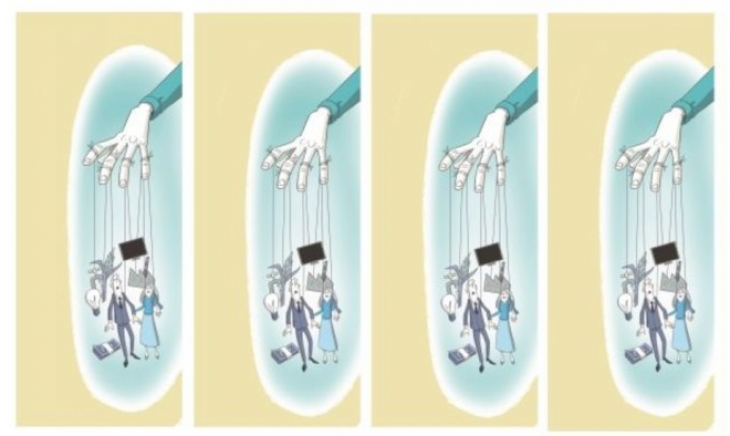
Religion, including Christianity, is an authentic experience of human flourishing and liberation if it does not become the monopolist of life, if it leaves room for other dimensions of existence.
by Luigino Bruni
published in Messaggero di Sant'Antonio on 04/03/2026
Criticism of monopolies is one of the universal laws of economics, because monopolies only lead to the general destruction of wealth and a reduction in the common good. Hence the call to do everything possible to ensure that societies equip themselves with the tools and agencies to prevent and combat monopolies. This anti-monopoly law actually has much broader applications than just the economic or industrial sphere. Monopolies are (almost) always wrong, in (almost) all expressions of social and personal life. Consider, for example, the religious life of individuals and communities.
Religion, including Christianity, is an authentic experience of human flourishing and liberation if it does not become a monopoly on life, if it leaves room for other dimensions of existence. In the Bible, only idols want a monopoly over their followers. The biblical God, on the other hand, is a liberator even from the tendencies of the temple and the priests to transform YHWH into a monopolistic idol that consumes the lives of the faithful, feeding on them with an insatiable hunger. The biblical God is a liberator, we know, and therefore also liberates from religions, including the religion of his own faithful. The prayer of the great German mystic Meister Eckhart (1260-1328) is noteworthy and evocative: “I pray to God to free me from God.” A God who frees us from himself is in fact the biblical God, as understood by the poet Friedrik Holderlin (1770-1843): “God created man as the sea creates the continents: by withdrawing.” .
The biblical and Christian God is not a consumer of his devotees; he does not feed on his creatures in order to live. He does exactly the opposite: he separates them from himself (shabbat), he wants them to be free and mature, that is, capable of not depending on the “religious” and the “sacred,” but of enjoying life and the whole of creation. The problem, however, is us, religious people, who, so accustomed to religion as idolatrous worship, create religious systems, temples, altars, sacrifices, a religious accounting between heaven and earth, because over the millennia we have conceived of deities as beings who are satisfied only by total, perfect, monopolistic worship. And so, despite the Bible and Jesus telling us exactly the opposite, even Christians have built temples, altars, sacrifices, religions of total and perennial worship, of lives oriented entirely and solely towards religion and God, as if there were superior beings above the sky who ask men to live only for them.
In this vision, which has dominated and still partly dominates Christianity, there are two problems. The first is theological: what kind of God do we have in mind when we think of him as a being who feeds on lives entirely devoted and offered to the sacred? Only idols want this, even if, deceiving ourselves, we give idols the names of YHWH or Jesus. Then there is an anthropological problem: what kind of human being do we have in mind when we give life to religions that occupy the entire space of our lives? What kind of man or woman is that believer who from morning to night thinks, lives, offers, and celebrates only to honor the Most High, only and always to celebrate the divinity? Only a minor, childish, servile, and unfree believer can feel comfortable in these religions. We do it; we have always done it.
But the Bible is there every day telling us: “Go ahead and do it if you care so much, but not in my name. My God does not want these worshippers, because he seeks worshippers in spirit and in truth. Therefore, be free, as sons and daughters.” Religion is a fully human experience only if it is an important aspect of life and renounces its monopoly on our existence.
Photo credit: © Fabiano Fiorin / MSA Archive