Major crises, along with disorientation and pain, also bring us a different and better perspective that allows us to see reality more clearly.
by Luigino Bruni
published in the Messaggero di Sant'Antonio on June 3, 2026
Major crises, along with disorientation and pain, also bring us a different and better perspective that allows us to see reality more clearly. We see this every day on a personal level, when a separation or a bereavement reveals to us who the other person truly was—the one who is no longer here—when a serious illness reveals to us what health was before it was lost, or when a war makes us see what peace was. And, even on a collective and social level, a sudden shock becomes a stress test to better see and understand the world and ourselves. Because crises are also revelations, unveilings: a veil falls, and finally we see everything more clearly.
The environmental crisis has shown us the immense value of the planet, water, the climate, snow, ice, and air, and this revelation has shown us that this understanding and awareness have most likely come too late to hope to reverse or halt the process of degradation.
The health crisis of the 2020–21 pandemic, in a space that had become very small and with social relationships suddenly mediated by screens, then revealed what hugs, kisses, and caresses truly were, and what the presence and scent of distant friends and family members meant. And, at the same time, it showed us another dimension of the market; we realized what logistics, goods, workers, and schools were, and we began to be more grateful to the people working around us, on the streets and in the shops; like when, in April 2020, I received Ascolan olives and Easter treats from my parents via courier, and in the hands of the truck driver who delivered that presence—that sacrament—of my deepest affections to my home, I saw a sacredness not too different from that present in the hands of the priest during Mass. Different liturgies, but always a celebration of the value of the social bond that allows us to live each day thanks to the mutual action of millions of human beings who work with and for us.
The current geopolitical and military crisis stemming from the aggression against Iran—motivated by the need to prevent the construction of an atomic bomb possessed (used, and recently threatened with) by the aggressor nations—is revealing other realities that were scarcely visible in ordinary times.
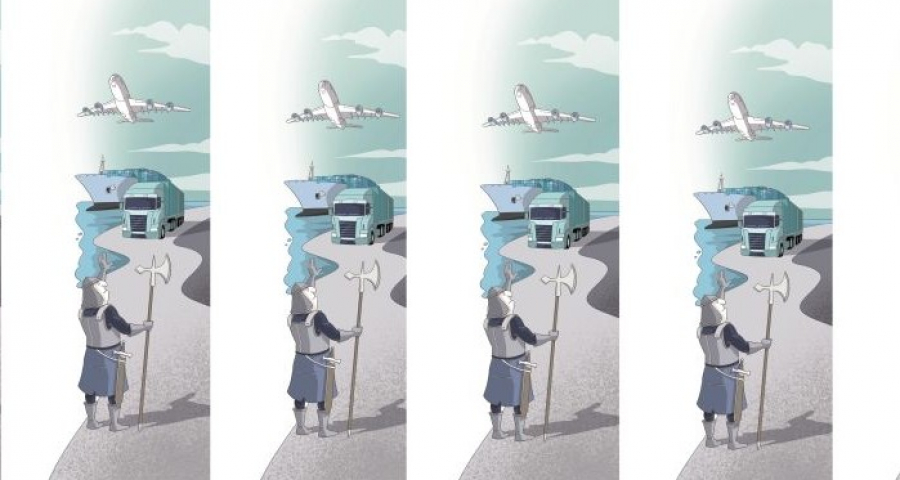
In an economic rhetoric that has been telling us for years that the real economy now matters less and less, that all the finance that matters travels online, that globalization and AI are eliminating old physical infrastructure, the closure of a port was enough—lowering the barrier in the oldest and simplest of physical structures—“Who are you? Where are you going? One florin!”—to suddenly wake us from our ideological slumber and realize that our global economy is very much like that of the twentieth century; that our globalization is still essentially very real, it is trade by ship and by container, that that closed port is throwing the world economy into crisis.
Finally, another veil has fallen: the illusion that we had truly made progress in the so-called “ecological transition,” that alternative energies would soon replace most fossil fuels, that oil was the energy of the 20th century and that the sun and wind were the new ones. Instead, the dream is over, and we find ourselves entirely dependent on that oil and gas transported by those ships across the sea. Ports, ships, oil: exactly as it was fifty years ago, exactly as it was a hundred years ago. Yet the wind still blows.
Photo Credit: © Fabiano Fiorin / MSA Archive