To understand the origins of the European economy, we must also look to monasteries, Franciscans, theologians, and pawnshops
by Luigino Bruni
published in Avvenire on September 22, 2026
Shakespeare’s "The Merchant of Venice" is a masterpiece in many respects, including its ability to show us that it is impossible to understand Italian and European finance without starting, right from the outset, with the essential intertwining of economics, religion, and faith. Usury, gift-giving, the Bible, forced baptism for Jews, merchants praised and usurers condemned—these are all characters, alongside Shylock, Antonio, Portia, and Bassanio, in The Merchant. The essay by journalist Alessandro Marzo Magno (The Invention of Money: When Finance Spoke Italian, Laterza, 286 pages, €20.00) treads on different ground, and for this reason, his history of money—though it contains some fine passages and valuable information—is not entirely convincing from a methodological standpoint.
There was a long period (much of the 20th century) when Italian and European economic history was narrated as an entirely secular affair, a laïcité understood in a bizarre and ideological way. In medieval history textbooks, including those on economic history, only a few pages were devoted to the economic role of monasteries, and generally none at all to the Franciscans, their economic and financial ideas, their Monti di Pietà and grain banks, or the ideas of Giovanni Olivi or Bartolo da Sassoferrato. If one examines classic texts on medieval history from the French historical school—from Bloch to Pirenne—the role of Christianity is relegated to one or, at most, two chapters (“the monk” and “the saint,” in Le Goff’s The Medieval Man), presented as two special cases within a narrative of medieval European history where Christianity and European society run on two parallel tracks, crossing only in connection with the political events of the papacy, the Crusades, and perhaps Cluny. The attitude of the Italian school was no different—from that of Armando Sapori or Gino Luzzatto, right up to Franco Cardini or Alessandro Barbero today, who has finally turned his attention to St. Francis in anticipation of the eighth centenary. As if it were possible to understand the history of European society, culture, science, art, and economics without a serious grasp of theology, the Bible, and church history.
In recent decades, thank God, things have been changing—especially, though not exclusively, in Italy. In France, for example, there has been a rediscovery of the economic role of monasteries, as seen in works such as those by Pierre Musso. The works of Adriano Prosperi—and, in a more strictly economic context, those of Maria Gabriella Muzzarelli, Giacomo Todeschini, Paola Pinelli, Luca Parisoli, and Francesca Trivellato—have shown that to understand not only European society but also its economy and finance, the Christian-Catholic element—often in dialogue with the Jewish tradition—is essential; it is not accidens but substantia. Christianity was the culture of the Middle Ages; everything was therefore viewed and interpreted within that worldview. This included accounting books, which—long before Pacioli and Cotrugli (as vividly recounted by Marzo Magno)—contained accounts in their “books of reason” registered under the name “Messer domineddio.” Not to mention monasticism. Monasteries were also the most important economic movement, at least until the commercial revolution (which also plunged monasticism—which was an agrarian economy—into crisis). While one world and its ancient economy were imploding (the Roman one), a new world and a new oikonomia were being built within the walls of the abbeys. An immense movement encapsulated in the motto ora et labora. Those monks understood that Europe would not rise again without also reviving labor and the economy. And so, while they preserved the manuscripts of Cicero and Isaiah, those monasteries also preserved knowledge of medicinal herbs, liqueurs, cheeses, wine, and oil; forestry and water management techniques; coin minting and accounting systems; and many mills—ancient cultures and crops. We know this today, but those who chronicled the birth of the market economy in the last century were somewhat less aware of it, and so they overlooked monasticism among the great architects of the new medieval economy. Those monasteries were also pioneers and custodians of accounting techniques, commercial codes, mercantile statutes, economic documents, and grain banks and other food banks providing essential staples for the population. The monasteries then became a European network of socio-cultural-spiritual hubs where, especially after the year 1000, fairs, trade, and exchanges flourished, because it was there that fides—trust—was safeguarded and nurtured. From the Gospel and from life itself, the early founding fathers (Benedict, Pachomius…) and later the reformers of monasticism understood that the economy was too important for life and that if it is not placed at the service of life, it becomes the master of everyone’s life, both inside and outside the monasteries and the Church. And so they took it upon themselves, creating the first great global experiment in cooperative economics in Christian Europe—the first European economic network. Religious charisms were the key players in the medieval economy. In the second millennium, it was the mendicant orders that continued these economic innovations—less spectacular and little studied, yet no less important for Europe. Without understanding the oikonomia of the Christian faith and its intertwining with the economy of currency, one cannot penetrate to the heart of the origins and history of the European economy, much less the Italian one; incidentally, Marzo Magno dismisses the entire history of finance and currency prior to Charlemagne in half a page, ignoring everything that had happened in Babylon, Greece, and Rome.
These considerations are now part of the standard repertoire of many medieval economic historians, because we have come to realize that it is impossible to understand the development of the Genoese or Florentine economy between the 13th and 14th centuries without taking seriously the role of the Franciscans, their economic ideas, their essential role in legitimizing the merchants’ trade, and their in-depth discussion of various forms of usury.
In Alessandro Marzo Magno’s comprehensive and well-written book, the religious element appears here and there, without constituting one of its central themes. And so, in the many pages devoted to the Middle Ages, the pawnshops—a fundamental Italian economic institution spanning the Middle Ages and the Early Modern period, originating before the Jews (pawnbroking is an institution of Roman law) and later revived and developed by the Franciscans of the Observance—are discussed in just a few pages, and with significant omissions and inaccuracies. For example, the seminal work by Marco da Montegallo is ignored, and the thesis—long since superseded—that the first “Monte di Pietà” was that of Perugia (1462) is repeated. The author does not delve into the logic behind how the “Monti” operated (except to reiterate the long-standing accusation of anti-Semitism, which is only partially true, as Todeschini and Pinelli have shown), nor into the motivation that led Bernardino da Feltre to favor lending at a moderate interest rate (around 5%), while Marco da Montegallo and his school—which was essentially based in the Marche region—were opposed to it. Bernardino, in fact, distinguished between interest on an (illicit) loan and interest for a (lawful) loan, and thus insisted on the payment of interest to make the Monte’s existence possible and thereby grant the loan, covering the costs of the Monte’s operations (including the management of auctions for unredeemed pledges) . There is no mention of the Monti Frumentari, the other major institution of solidarity-based and rural finance founded by the Franciscans and which continued to operate in thousands of cities and towns until the 20th century. Even the references to prohibitions on usurious lending remain superficial, for many reasons that ultimately point to a lack of theological and biblical analysis of the phenomenon. Moreover, had the book analyzed Scipione Maffei’s work, Sull’impiego del denaro (1744), it would have uncovered many important insights into the deep roots of the debates on usury in past centuries—including the debate (with the traditionalist theologians Concina and Ballerini) that led, the following year, to Benedict XIV’s first encyclical, which in certain cases legitimized a (moderate) interest.
It is unreasonable to expect authors of books on the history of money in Italy to be experts in theology, the Bible, and church history—that would be asking too much; but perhaps, today, to write good essays, one must know more about these subjects than was required thirty years ago, and it is necessary to study history in truly interdisciplinary research groups, reevaluating—from a secular perspective—theological and biblical expertise.
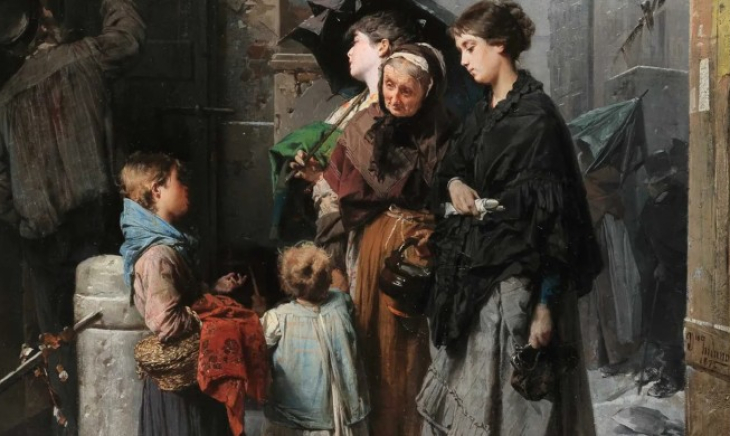
Image: Domenico Induno, “Monte di Pietà,” 1856 (detail) / WikiCommons
,_by_Domenico_Induno.jpg)