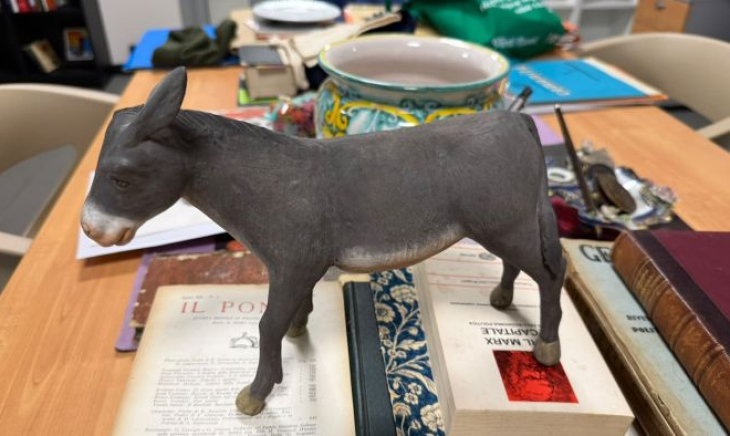
The Bank of Italy’s guide for elementary school students ignores a body of literature in economics, psychology, and pedagogy that for decades has cast doubt on the benefits of giving children—let alone young children—an allowance. Financial education at the wrong time isn’t just useless; it’s harmful
by Luigino Bruni
published in Avvenire on 10/27/2026
Pinocchio’s encounter with the Cat and the Fox is an integral part of the narrative put forward by advocates of financial education for children and young people in schools. This is because teaching children and young people the language of finance would mean equipping them to recognize and defend themselves against the many Cats and Foxes. Consequently, in recent years, everyone has been applauding financial education initiatives in schools launched by the Bank of Italy, Consob, and many banks and associations (Feduf). Riding the wave of this enthusiasm, the government has made financial education mandatory in Italian schools at all levels (Law No. 21 of March 5, 2024). The reality, however, is more complex and quite different from what was imagined. Recent disturbing acts by “kids” strongly suggest that schools need everything except financial education. Today’s schoolchildren have an immense need to relearn the meaning and nature of things and objects, to touch and smell them, to understand their value, so that tomorrow they can also understand their price.
The Bank of Italy has written an (online) guide for elementary school students. As I scrolled through it, I felt a chill run down my spine at the mere thought of that material ending up in the hands of children and their teachers. Thirty years ago, something like this would have been unthinkable, because the general paradigm of a good life in society was democracy; today, with business having become the dominant culture, what would have been considered an abuse yesterday has become the norm. And no one protests. In any book, the beginning is always important. This one, in fact, begins with “allowance,” which the Bank of Italy obviously considers a good method for educating six- or eight-year-olds. It thus ignores an entire body of literature in economics, psychology, and pedagogy that for decades has cast endless doubt on the benefits of giving allowance to teenagers—let alone to children. For example, as early as the 1970s, controlled experiments on the introduction of an allowance in families (e.g., the work of David Greene and Mark R. Lepper, 1974) showed that children raised this way develop, over time, a lesser inclination to engage in activities driven solely by intrinsic motivations—which are the decisive ones in life, starting with work. Introducing the logic of an allowance into our relationships with children—and, more generally, subjecting them to economic and financial logic—makes it much more difficult to educate them in the ethics of virtue, which requires radically different ingredients. The theoretical and empirical evidence on these issues is now vast. Furthermore, an allowance brings with it the use of monetary incentives within the home, because children begin to associate doing small chores with receiving a sum of money (5 euros for washing dishes, 4 for taking Grandpa for a walk, 5 for walking the dog…). These are two theoretically distinct tools, yet they often coexist, as both stem from the same encroachment of business logic into families and society at large. Furthermore, in that elegant and charming guide for children, the book uses allowance as a starting point to explain what parents’ income is—defined as the evolution of their own allowance: “Yes,” we read, “a salary is a kind of super-allowance.” This commits a major error—both theoretical and practical—because it overlooks the fact that earned income (wages and salaries) stems from a structure of reciprocity: income is paid to the worker in exchange for labor, which is precisely what is missing from an allowance, meaning it has nothing to do with wages and salaries (it would be more akin, if one were to insist, to a universal basic income). Behind our kids’ desire for shiny goods—which sometimes leads them to smash store windows just to get them—lies a lack of understanding of the market’s reciprocal nature: to get goods, you have to give something in return; you have to earn an income. Income is not a “super allowance”; it is the exact opposite. Even more serious is the notion that an allowance is a payment made to good and well-behaved children—children’s right to goods does not derive from a contract but from their status as sons and daughters, whether good or bad, hardworking or lazy.
These are errors, therefore, especially when propagated by the Bank of Italy—because the fact then becomes ethically commendable as well: it is good to give your children an allowance. The rest of the booklet is devoted to explaining the functions of money, GDP, savings, and even taxes. Writing economics books for children is extremely difficult, because only a high level of theoretical and interdisciplinary expertise allows one to simplify very complex concepts without making mistakes. In the vast majority of cases, however, attempts to adapt, mediate, or simplify the language of economics and finance to make it understandable to children end up distorting economics and finance—subjects that require readers old enough to grasp their complexity. Economics isn’t all that different, in terms of complexity, from mechanics or engineering—and I don’t think anyone would try to teach those to a seven-year-old.
Let’s return to the wonderful episode of Pinocchio grappling with the Cat and the Fox. And let’s imagine another Pinocchio who has read and studied the guide to financial literacy. No person of sound judgment could think that this other Pinocchio would have been equipped by that little book to defend himself against the cats and foxes of finance, because the information asymmetry between the two sides would still be infinite. The only serious and responsible message—probably very close to what Collodi had in mind—that should be conveyed to Pinocchio and his child friends, and above all to parents, schools, educators, and policymakers, is the following: keep children away from the world, the language, and the logic of economics and finance. It is no coincidence, incidentally, that all of Pinocchio’s troubles begin when he comes into contact with adults’ money: from the money he receives from selling his alphabet book to a junk dealer (an economic exploitation by an adult), to the gold coins Mangiafoco gives him, to the Field of Miracles.
One important element should also be noted: the two scoundrels seduce Pinocchio by manipulating the language of the gift: “We,” continued the Fox, “do not work for base gain; we work solely to enrich others.” “Others!” repeated the Cat. “What fine people!” thought Pinocchio to himself (Chapter XII). To economically exploit a child, the only effective language is that of the gift, because it is the child’s mother tongue—the language of home and of basic trust. Talking to children about taxes, GDP, work, money, and savings is like talking to a blind person about colors. The objects and concepts of economics are “goods of experience,” which can only be understood by experiencing them at the same time. Childhood is a time of generosity, of giving, and of intrinsic motivation. They will learn about the economy and finance—the knowledge they’ll need tomorrow—only when they have to use it: from adolescence onward. Instead, it is the banks, insurance companies, and large corporations that should educate themselves on how to maintain an ethical and fair relationship with citizens, who will always be far less informed than they are.
The only “stock market” that is good for children is the one made up of parents, teachers, and the adults around them, because their encounter with the economy and money must be strictly mediated by those who educate them. Economic autonomy is important for adults, perhaps for young people, but not for children and preteens, who must depend on Mom and Dad. Financial education is a direct expression of the general education of boys and girls, much like sex education, and discussing it at the “wrong time” is not only useless—it is harmful. Pinocchio’s ill-fated encounter with the Cat and the Fox will lead to his hanging (Chapter XV). Because getting one’s relationship with money wrong as a child means getting one’s relationship with life wrong.